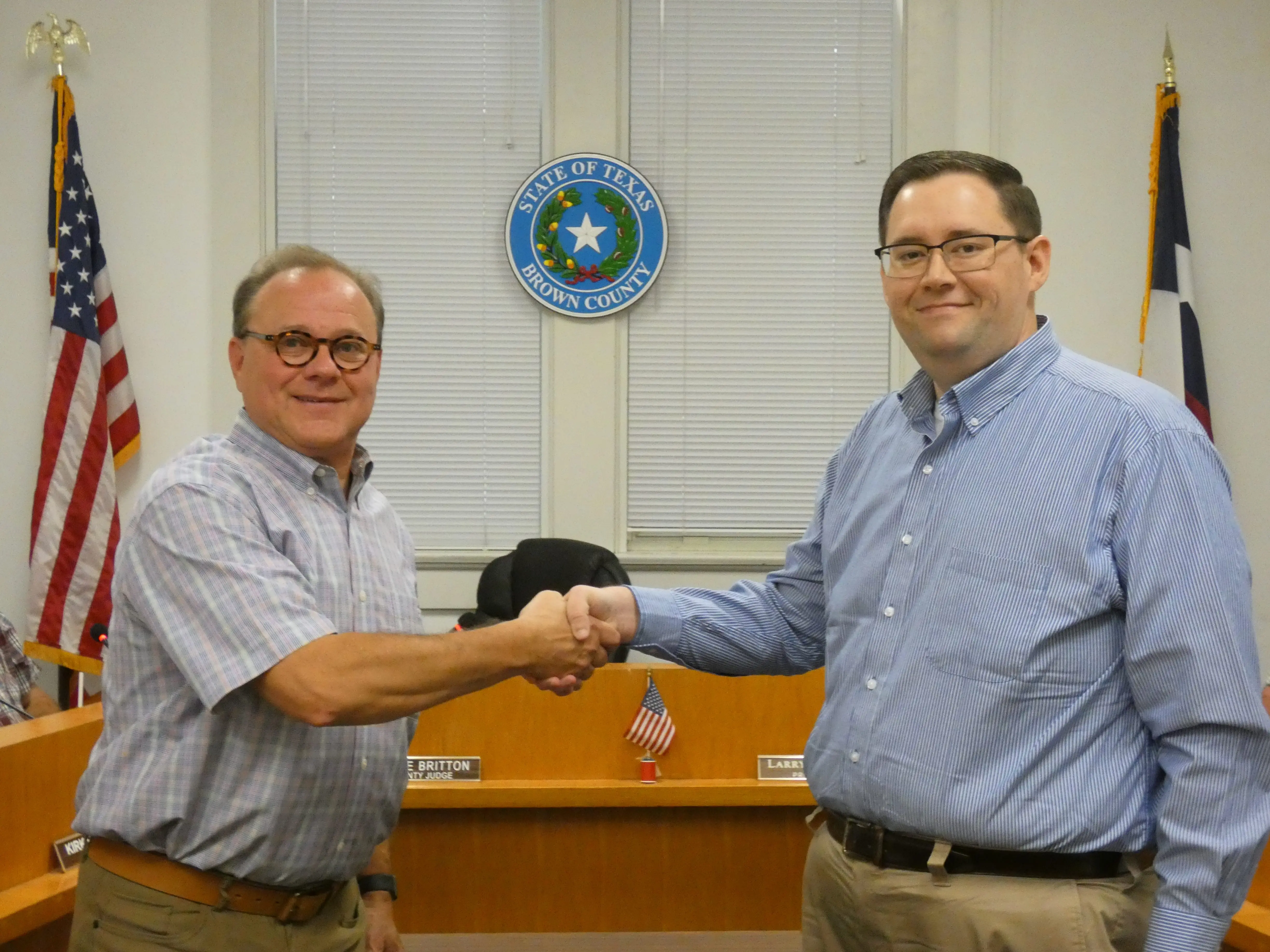
At Monday’s meeting of the Brown County Commissioners Court, Cliff Karnes was appointed as Emergency Management Coordinator for Brown County. The previous Emergency Management Coordinator, Darrell Johnston, retired at the end of 2024. Brownwood Fire Chief Eric Hicks filled in at that job for six months, but his term has expired. Karnes, who currently works for the Brownwood/Brown County Health Department as Public Health Preparedness Manager, will begin his new job on October 1. County Judge Shane Britton praised Karnes as uniquely experienced and qualified for the position.
Cliff Karnes grew up in Early and was graduated from Early High School in 2004. Four years later he received a degree from Howard Payne University in Social Studies Education. “I wanted to be a social studies teacher,” Karnes said. “I’m kind of a political science junkie, so I also hoped to teach high school government, and maybe history, second.” While still in college at Howard Payne, he worked part-time at the Sheriff’s Office, initially as a commissary/visitation clerk. After graduation from college he continued to work for the Sheriff’s Department full-time, as a medical clerk. In that job, he worked with the Brownwood/Brown County Health Department, which hired him in 2013 as the Public Health Preparedness Coordinator.
To further his skills in the new job, Karnes in 2015 enrolled online in Sam Houston State University. In 2017 he received a Master’s Degree in Public Administration, with a concentration in Disaster and Emergency Management. In 2023 Karnes taught an Emergency Management course online for Sam Houston State, as part of the graduate Master’s in Public Administration program. Also in 2024 he began teaching an American Government class online for Howard Payne University.
Karnes said his current job at the Health Department has three areas: (1) Emergency Planning. “We write the plans for the Emergency Support Function Aids, which are health and medical services, and the Emergency Support Function List, which is guided by FEMA (Federal Emergency Management Agency). (2) Epidemiology “By statute there is a list of notify-able conditions that have to be reported to Public Health. They range from less-serious diseases all the way up to Category-A bioagents like the plague, anthrax, etc.” An example is the listeria outbreak at the Blue Bell ice cream factory in Brenham Texas several years ago. (3) Volunteer Management, which deals with the Brown County Medical Reserve Corp.
The Public Health Emergency Preparedness Program has six domains of preparedness: (1) Community Resilience. Preparing for and recovering from emergencies (2) Incident Management. Coordinating an effective response. (3) Information Management. Making sure people have information to take action. (4) Countermeasures and Mitigation. Getting medicine and supplies where they are needed. (5) Surge Management. Expanding medical services to handle large events. (6) Biosurveillance. Investigating and identifying health threats.
After the flooding disaster in Kerr County in July, the Texas Legislature passed an Omnibus Disaster Management Reform Bill, which will require state licensing for emergency managers beginning in 2027. Karnes says the licenses will be similar to those required for law enforcement and fire fighters. “There is more demand for professionalism in the field.”
As County Emergency Management Coordinator, Karnes says he will be responsible to plan for four components. Mitigation: identify and minimize hazards, trying to prevent the hazard from occurring. Preparedness: putting things in place through training and exercising to enable a response. Response: going into action when an emergency situation occurs. Recovery: This involves short term, intermediate term, and long term recovery efforts. “Recovery is probably the most neglected, because people don’t really think about the time it takes to recover,” said Karnes. “There are things we need to work on, especially the training and exercise. A lot of people are confused as to what emergency management is. It’s not just another first responder department. There’s a lot that goes into it that is not just response, such as mitigating the hazard, that happens long before the emergency occurs.”
The State of Texas is requiring more in the way of developing plans, which have to updated every five years, and the plans have to be executable. Karnes says he will work with the Cities of Brownwood, Bangs, Early, Blanket, etc., as well as Hendrick Medical Center and the local industrial plants. Chief Hicks just recently completed an update to the County’s Hazard Mitigation Plan, as required by FEMA to qualify for funding.
When asked what are the most likely emergencies in Brown County, Karnes mentioned wildfires, flooding, tornadoes, and other types of severe weather such as temperature extremes and high winds. But many other kinds of emergencies can occur and must be planned for, such as widespread disease outbreaks, accidents that can release hazardous materials or shut down electrical power, and even hazardous conditions intentionally caused by evil actors.
Governments at all levels, from cities and counties to states and federal, can do only so much, so fast. Karnes emphasized the importance of emergency preparedness on an individual level. “Think of your family, and the first few days after a disaster, because it takes time for government to mobilize.” He recommends everyone to store water and non-perishable food. Make sure medications are in a safe place, as well as medical equipment. Make duplicate copies of vital records and store them in a safe place. And plan for your pets’ needs.
When asked if any teachers in particular inspired him, Karnes mentioned Bill Thedford, 6th-grade world history; Pam Jenkins, biology; Mike Helms, government and economics; and Rhonda Howard and Jan Guest, English.
Cliff Karnes is looking forward to his new job with Brown County. But he says “Emergency Managers don’t get any recognition, but when disaster strikes they get either the credit or the blame.” Karnes is hoping and planning to get the credit for good emergency management.