The Brownwood Area Chamber of Commerce held its biennial Economic Summit last week on Thursday, February 26. A large crowd listened to eight speakers provide information about various topics of economic data for Brown County, including economic development, demographics, real estate, workforce, and political efforts for the economy. The Summit was held in the Mabee Center on the campus of Howard Payne University. Some highlights of the Economic Summit presentations are below.
City of Brownwood
City Manager Marshal McIntosh and Deputy City Manager Ray Tipton spoke of the economic development priorities of City Hall. Those include Industrial Growth, Housing, Downtown Revitalization, Retail Growth, Quality of Life Improvements, and Tourism.
INDUSTRY: The two largest industries here recently celebrated birthdays in Brown County. 3M has been here 60 years, and Kohler has been here 50 years. Kohler recently announced an 80-acre expansion for infrastructure development. Unemployment in Brown County is lower than Texas and the United States as a whole. As of December 2025: Brown County – 3.5%; Texas – 3.9%; U.S. – 4.1%.
HOUSING: From 2021 through 2025, the City issued 80 certificates of occupation for new residential homes. Since 2017, 234 new apartment units have been constructed.
DOWNTOWN: Phase One of the new Downtown Master Plan was adopted in 2024. Design and engineering work is being done currently. Construction is expected to begin in 2027. It will include the Fisk and Baker Streetscapes, which will have new roadwork, sidewalks, lighting, landscapes, and underground utilities. New public parking downtown, up to 59 spaces, will be added. A new downtown park, Founders Crossing, will be added on Fisk Ave. It will be constructed on a currently vacant lot, donated by Texas Bank. It will be called Founders Crossing because the four streets surrounding the park – Fisk, Chandler, Anderson, and Hawkins – were named after early founders of Brownwood.
RETAIL: New Brownwood retailers in 2025 included Tropical Smoothie Cafe, Seven Brew Coffee, Panda Express, Pinkie’s Liquor, and Ollie’s Bargain Outlet. New retailers coming this year in Commerce Square will include Five Below, Bath and Body Works, Ulta Beauty, James Avery Jewelry, and Ross Dress for Less. The retail sales tax collected in 2025 totaled $10,196,700, exceeding $10 million for the first time. The sales tax in Brownwood has grown 47% since 2015.
QUALITY OF LIFE IMPROVEMENTS: The Phase I improvements in Riverside Park are complete, consisting primarily of infrastructure such as roads, parking, fencing, sidewalks, and electrical service. Phase II will be done next, including improvements to playground, picnic, and recreational facilities. Improvements to Coggin Park are now complete, including new basketball, tennis, and pickleball courts, walking trail, and lighting. Upcoming will be improvements to the Bennie Houston Center and the Veterans Memorial Park.
TOURISM: Direct visitor spending in 2024 was $38,500,000, an increase of 29% since 2020. Sports tourism included 57 events, which brought 55,510 visitors to town, causing 8,856 hotel stays, and a total economic impact of $3.1 million. The Brownwood Event Center hosted 68 events in 2025 with 18,720 attendees. For 2026, 48 events have already been booked in the Event Center.
Texas Demographic Center
Dr. Helen You, of the Texas Demographic Center in San Antonio, presented demographic data and information on Brown County and the State of Texas. The population of Texas is currently estimated at 31.7 million persons. That is an increase of 1.2%, or 391,000, since 2024. That growth is the largest of all fifty states. The nationwide population growth rate from 2024 to 2025 was 0.5%. In 2025 Texas added an average of 1072 persons per day. The population increase was about 17% domestic immigration, 43% international immigration, and 40% natural growth.
As of July 1, 2024, the population of Brown County was 38,631, and Brownwood 18,772. In the County, 20.0% of the population was below 18 years of age, and 21.7% were 65 years of age and above. The owner-occupied housing in the County was 68.3% of the population, and 54.8% in Brownwood. The median value of the owner-occupied housing was $158,900 in the County, and $144,400 in Brownwood. The median home value in Texas was $296,000, which represents an increase of 70% since 2013.
The total population of Texas is expected to be 42,000,000 in 2060. The metro areas are expected to contribute 99% of the population growth. Brown County population is expected to grow 9% by 2060, while most Counties in Central and West Texas are expected to have a decrease in population by 2060.
Real Estate
Local real estate data was provided by Carrie Dunn, President of the Heartland Association of Realtors. The local real estate market experienced very high numbers during the pandemic a few years ago. Now the market is back to normal, moderate sales activity. The number of houses and buildings on the market is expanding currently. The number of days for sale on the market has increased slightly. The local market is experiencing a slower, more sustainable growth in prices. Data in Brown County in 2025: Median Sales Price $219,998, an increase of 4.8% over 2024; Active Listings 212, up 16.5% over 2024; Closed Sales 436, up 8.5% over 2024; Days on Market plus Days to Close, 115, up 13 days over 2024.
Workforce
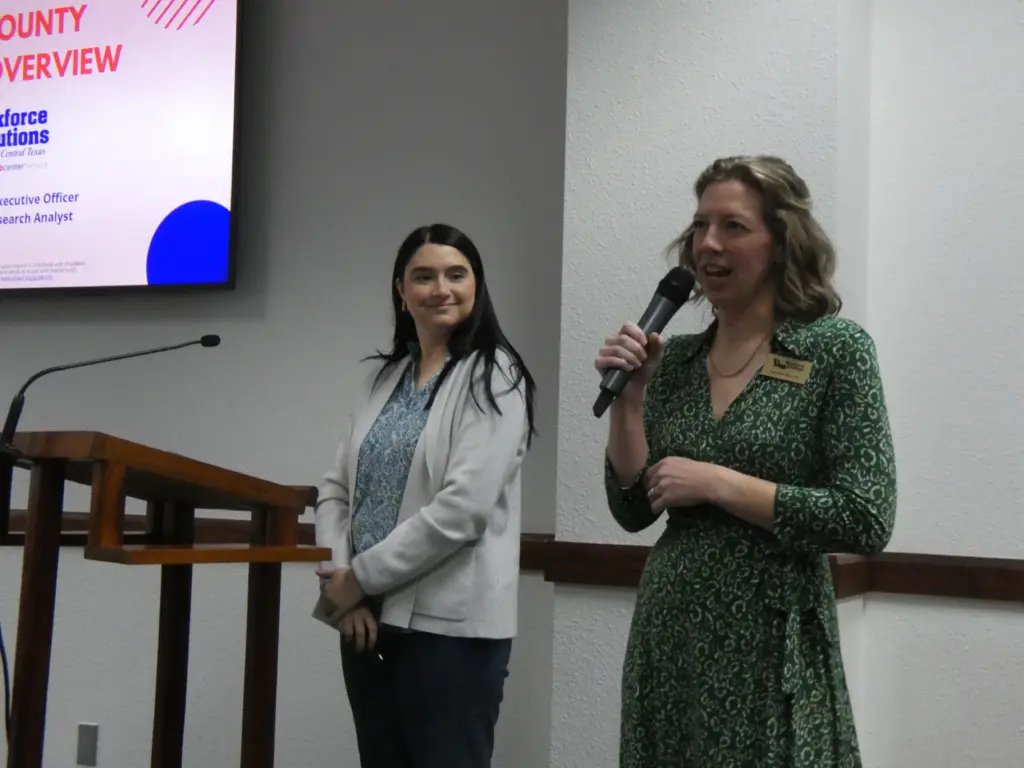
Information provided by Amelia Reeves and Aimee Allen, from Workforce Solutions of West Central Texas. Jobs in Brownwood are projected to grow by 773 over the next five years. Manufacturing and Health Care will provide the majority of the new jobs.
Texas Representative David Spiller
Representative Spiller first talked about the importance of water resources. The Texas Legislature passed SB-7, the Texas Water Fund which provides $2.5 billion for water infrastructure, supply, development, conservation, and drought resilience. “Water isn’t just an environmental concern, it’s an economic development issue,” said Spiller. “You can’t have economic success if you don’t have adequate water… Because you can’t recruit new businesses, you can’t have adequate housing and the housing growth you need. You can’t sustain agriculture and long-term growth if you don’t have adequate water.”
Transportation: Spiller said that County Roads and Farm-to-Market Roads now have more traffic and heavier traffic than they were designed for. The State of Texas has allocated $30 billion for improvements to the state’s transportation system.
Workforce: “A huge part of workforce is education,” said Spiller. The state budget includes $75 billion in public education, an increase of $8.5 billion. Of the increase, $4.2 billion is for teacher pay increases. $1.0 billion is designated for small and mid-size school systems, such as those in Brownwood and Brown County.
“Rural Texas is the backbone of our state, and the backbone of our economic development in the state,” said Spiller. “Rural Texas produces our energy and our agriculture. We wouldn’t have the Texas economy and the strengths we have without Rural Texas.”
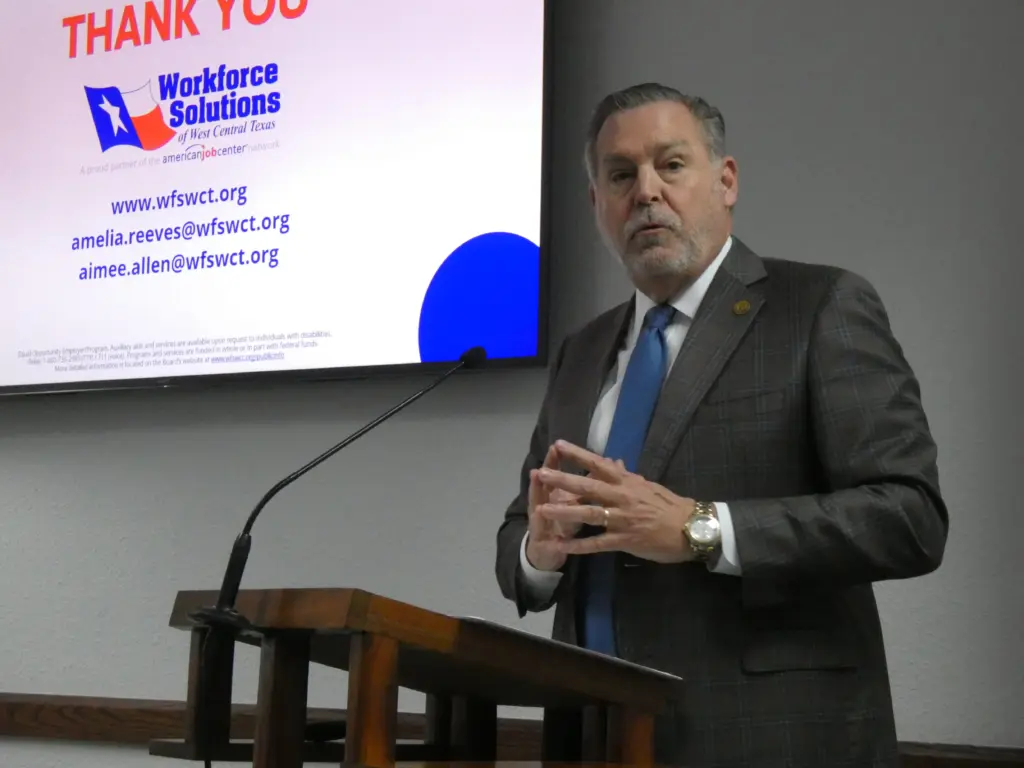
Texas Senator Phil King
Senator King provided many interesting statistics concerning the Texas economy:
*** The Texas Gross Domestic Product is $2.7 trillion, up 39% since 2010.
*** If Texas were a separate nation, it would have the 8th largest economy in the world, just behind Italy.
*** Texas has been the largest exporting state in the U.S. for 23 years in a row.
*** Texas leads the nation in the production of crude oil (40%) and natural gas (23%).
*** Texas 37 public 4-year universities, and 40 private colleges/universities.
*** Texas has 15 major medical universities. The M.D. Anderson Health Center in Houston is the #1 cancer hospital in the country.
*** The DFW Airport is the 3rd busiest airport in the world.
*** One out of ten publicly traded business are located in Texas. Texas has 3.5 million small businesses.
*** Texas is the leading destination for corporate relocation. Since 2020, over 140 major business have moved to Texas.
*** Texas is the most popular destination for Americans relocating from another state.
The reasons for the last two above, according to King, is that Texas has no income tax and no capital gains tax. Housing is less expensive in Texas. Texas does not over-regulate. And the workforce in Texas is better educated than most states.
“Texas is doing great,” said King. “Our communities are doing great. Everybody wants to be in Texas. There is no better place to live in the world, no better place to live in the United States than Texas. And I think no better place to live in Texas, than rural Texas!”