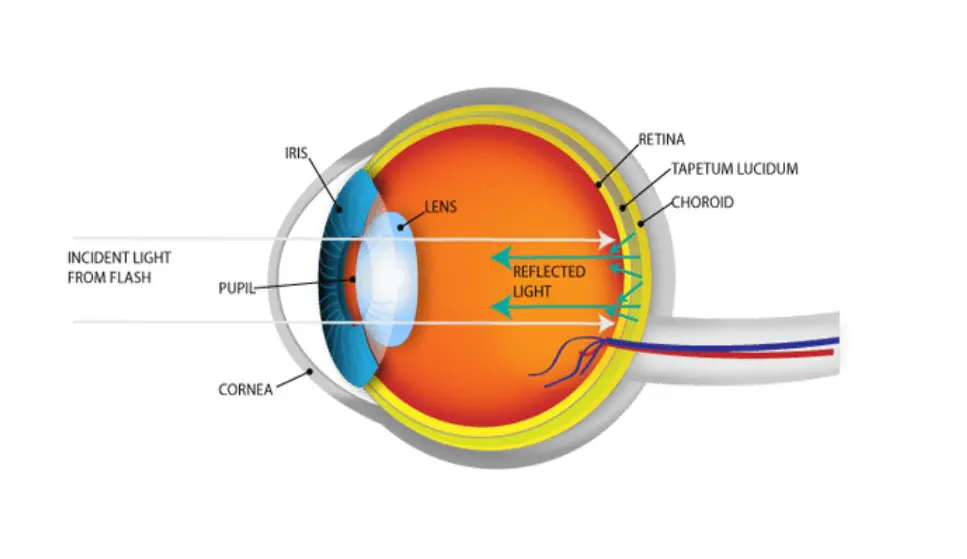
According to Extension specialists, you can see white-tailed deer eye shine at night but not feral hogs. The difference is in how white-tailed deer and feral hogs respond to light at night—specifically, why deer eyes shine brightly while hogs’ eyes usually do not—has to do with a structure called the tapetum lucidum.
The tapetum lucidum is a reflective layer located behind the retina in the eyes of many nocturnal and crepuscular animals. It acts like a mirror, reflecting light that passes through the retina back into the photoreceptor cells, effectively giving the eye a second chance to absorb light. This enhances night vision and creates the glowing “eye shine” effect when light hits the eyes at night.
White-tailed deer have a well-developed tapetum lucidum, which helps them see in low-light conditions, crucial for their crepuscular (dawn/dusk) and nocturnal activity patterns. When you shine a spotlight at a deer at night, the tapetum reflects it back, producing a bright green, yellow, or white glow depending on the angle and intensity of the light.
Feral hogs, on the other hand, do not have a tapetum lucidum. As a result, they do not exhibit significant eye shine when illuminated at night, which is also associated with poor to moderate eyesight during these times.
Other species of interest:
Bobcat – Tapetum lucidum present
Coyote – Tapetum lucidum present
Javelina – Tapetum lucidum absent
Opossums – Tapetum lucidum present
Raccoons – Tapetum lucidum present