The following article is Sponsored by GoRout
Not long ago, a high school offensive coordinator calling plays from the sideline was working almost entirely from memory — a laminated sheet of formations, a headset that crackled in cold weather, and a mental model of the defense built up over two quarters of observation. College programs, by contrast, had dedicated analysts in press boxes, real-time data feeds, and communication systems that kept the entire coaching staff connected on every snap.
That gap has not disappeared. But it has narrowed in ways that would have seemed unlikely a decade ago, driven by falling technology costs, wider access to coaching education, and a new generation of coordinators who grew up watching college football analytically rather than just as fans.
The Communication Problem That Held Programs Back
For years, the most visible difference between high school and college play-calling was not the sophistication of the schemes — plenty of high school coaches run complex offenses — but the speed and reliability of the communication behind them. A college quarterback receives a play call through a helmet speaker with a few seconds to spare, processes it, and gets the team to the line with time to make adjustments. A high school quarterback reads a wristband, gets a hand signal from the sideline, or listens for a call that the crowd noise may have swallowed entirely.
Miscommunication at the line of scrimmage is rarely about schemes. It is about the chain between the coordinator’s decision and the quarterback’s execution. When that chain is unreliable, coordinators simplify — not because they lack the knowledge to run something more sophisticated, but because complexity requires dependable communication to function.
This is where wristband-based play-calling systems have made a measurable difference at the high school level. Rather than relying on sideline signals or verbal calls vulnerable to crowd noise and defensive attention, a coordinated football play calling system gives coordinators a direct, reliable channel to communicate with skill positions on every down — the same infrastructure that made college play-calling faster and more consistent.
What Wristband Systems Actually Change on the Field
When a coordinator can trust that the play call will arrive correctly, the nature of what they can call changes. Tempo becomes a real tactical option rather than a theoretical one. A no-huddle drive that forces a defense to stay in a base package requires confident communication; if the quarterback might misread the wristband or the receiver might not catch the signal, the risk of a procedure penalty or a wrong route outweighs the tactical benefit.
With reliable communication in place, high school coordinators are running up-tempo series with the same intent as college programs: wearing down a defense, preventing substitutions, and creating favorable matchups before the defense can adjust. Programs that adopted wristband systems in the past few seasons report that the change affected their tempo game more than any other element — not because they added new plays, but because they could now actually use what they already had.
Pre-snap motion and shifts, which require precise timing between the snap count and the movement, are another area where communication quality shows up directly in execution. When a receiver knows exactly what motion he is running and when, and the quarterback knows exactly what protection adjustment follows, motion packages run cleanly. When either player is uncertain because the signal was ambiguous, motion creates chaos rather than advantage.
The Coordinator’s Role Has Evolved
The coordinator who benefits most from these systems is not one who simply calls more plays. It is one who uses the reliability of communication to make better decisions mid-drive. College coordinators have long had the ability to adjust based on what they saw on the previous possession — pulling up a tendency from the defensive coordinator’s notes, calling a play designed specifically for a leverage the defense just showed. High school coordinators are beginning to operate the same way.
Some programs have added a simple spotting system in the press box — a second coach watching the defensive alignment and relaying tendencies down to the sideline between series. This is a version of what college staff have done for decades. At the high school level, it was difficult to act on press box observations when the sideline communication was unreliable. With a dependable play delivery system in place, the information flow from the press box actually translates into adjusted play-calling.
The coordinator’s job has shifted from managing communication uncertainty to managing football decisions. That is a meaningful change in what the role demands and what it can produce.
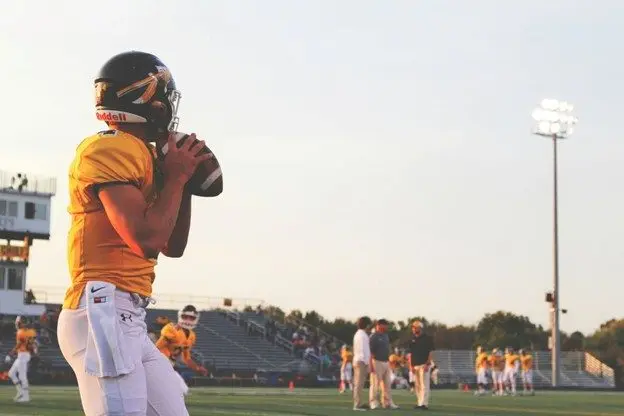
Photo by Riley McCullough on Unsplash
Player Development Follows the Infrastructure
One consequence of better play delivery systems that gets less attention than scheme sophistication is what happens to player development. A quarterback who operates within a clean, consistent communication system throughout high school arrives at the college level with habits that college coaches can build on. Reading a wristband quickly, processing a call with multiple options, understanding the relationship between a formation tag and a protection adjustment — these are skills that take repetition to develop, and they develop faster when the delivery mechanism is consistent.
College coaches who recruit quarterbacks from programs using modern communication systems report a noticeable difference in processing speed. The player has done it hundreds of times already. The mechanics are not new. What college coaches add is the next layer of complexity, not the foundational habits.
Receivers benefit similarly. A route runner who has spent three years executing based on clear, reliable pre-snap communication understands his assignment differently than one who spent those years guessing through ambiguous sideline signals. Route precision at the high school level used to be partly a communication problem. Better play delivery systems have removed that variable.
Where the Gap Still Exists
Acknowledging the progress does not require overstating it. High school programs still operate without the personnel depth, preparation time, and analytical resources that college staffs have. A college offensive coordinator calling a third-and-six at a critical point in the season has a week of film study, a full analytics staff, and a roster built around specific scheme advantages. A high school coordinator calling the same situation has evenings, a laptop, and a staff with other jobs.
The value of better play-calling infrastructure at the high school level is not that it closes every gap. It is that it closes the gap that was most directly in the way — the communication gap that prevented capable coordinators from running what they knew. Once that barrier comes down, the limiting factor becomes football knowledge and preparation, which is a more manageable problem than infrastructure.
Programs that have invested in modern play delivery systems over the past few years are not running college football. They are running high school football with fewer unnecessary limitations — and for the players coming through those programs, that difference shows up where it matters most.