How about going on a ‘pork procurement’ hunt with me in this week’s column? I’ve been a devout hog hunter for much of my adult life. My adrenaline begins to pump when I am setting over a corn feeder at night and spot hogs through my thermal scope. It’s the same adrenaline rush that comes with catching a big bass or striper or spotting a big buck slipping through the woods. Wild hogs, especially those that have been hunted, tend to come out of the brush to feed each evening just as the sun disappears over the western horizon. Oh, occasionally on a cloudy or rainy day, wild porkers can be seen out feeding during daylight hours but because of hunting pressure, they have become mostly nocturnal.
For the past quarter century, I have been fortunate to live a stone’s throw from land that harbors a heavy population of wild porkers. I have a couple of great neighbor friends that own ranches along a slough that attract and hold lots of hogs and am thankful to be allowed to hunt and fish on these hog ‘honey holes’, each within a mile of my home. They are happy to have me remove hogs from their ranches and I am overjoyed for the opportunity for the opportunity to hunt close to home and for the meat. Yes, I said meat! Many people frown at eating wild hogs and I am the first to admit not every wild porker will make great pork. I understand the differences between wild and domestic pork and I know how to turn wild porkers into tasty table fare. When asked if wild hogs are good to eat, I answer with a question of my own, “If you were going to a livestock auction to buy a hog to eat, which would you choose, a young fat hog or a rank old boar”? My question usually answers theirs.
I’ve probably become the pickiest hog hunter in Texas. My time in the woods can be likened to someone shopping at a meat market for choice cuts of meat. I’m not a run and gun hog hunter; I set up close to a corn feeder where I expect to see hogs and pick the one I want to shoot and turn into pork. When I spot my pork, I aim for the center of the neck right behind the jaw and drop it with a light caliber (.223). I’m no super marksman, I’m shooting a standing target usually at about fifty years. I usually target younger hogs weighing from about sixty pounds to just over 100 pounds but last week, I made an exception I want to tell you about.
For the past seven years, I help host the Luke Clayton Outdoor Ron-De-Voux at the Top Rail Cowboy Church in Greenville. It’s an outdoor event with chuck wagon teams, fish frys, live music and lots of booth selling everything from jewelry to catfish bait. I usually try to supply the fish and this year I have been fortunate to have a freezer full of tasty blue catfish. But I also like to offer tasty smoked BBQ from game meat, often wild pork. The hunt this past week was for a tasty young porker, preferably a 100 pound gilt (young sow) which I consider to be the best eating from the wild, but fate and the excitement of the arrival of one of the biggest boars I’ve seen in years changed my plans.
I was in my comfortable hunting blind (the bed of my pickup), setting in a padded swivel office chair with a bottle of tea within arm’s reach. I got settled in about 15 minutes before dark and when the night woods became black, I switched on my ATN Thor mini 6 thermal scope and began scanning the area. On cue, a small sounder of 3 sows with about 20 piglets begin rooting around for worms and grubs in a pile of hay across the fence. The pigs were too small to eat and I don’t shoot sows with small pigs. Besides, my neighbor’s cattle were also munching on the hay and I wouldn’t risk the shot.
I spotted several bigger hogs on the edge of the woods a hundred yards away but they were near the cattle and didn’t present a shot, besides I like to wait for a close shot, I want to anchor my pork on the spot rather than spending time looking for a wounded one, especially at night.
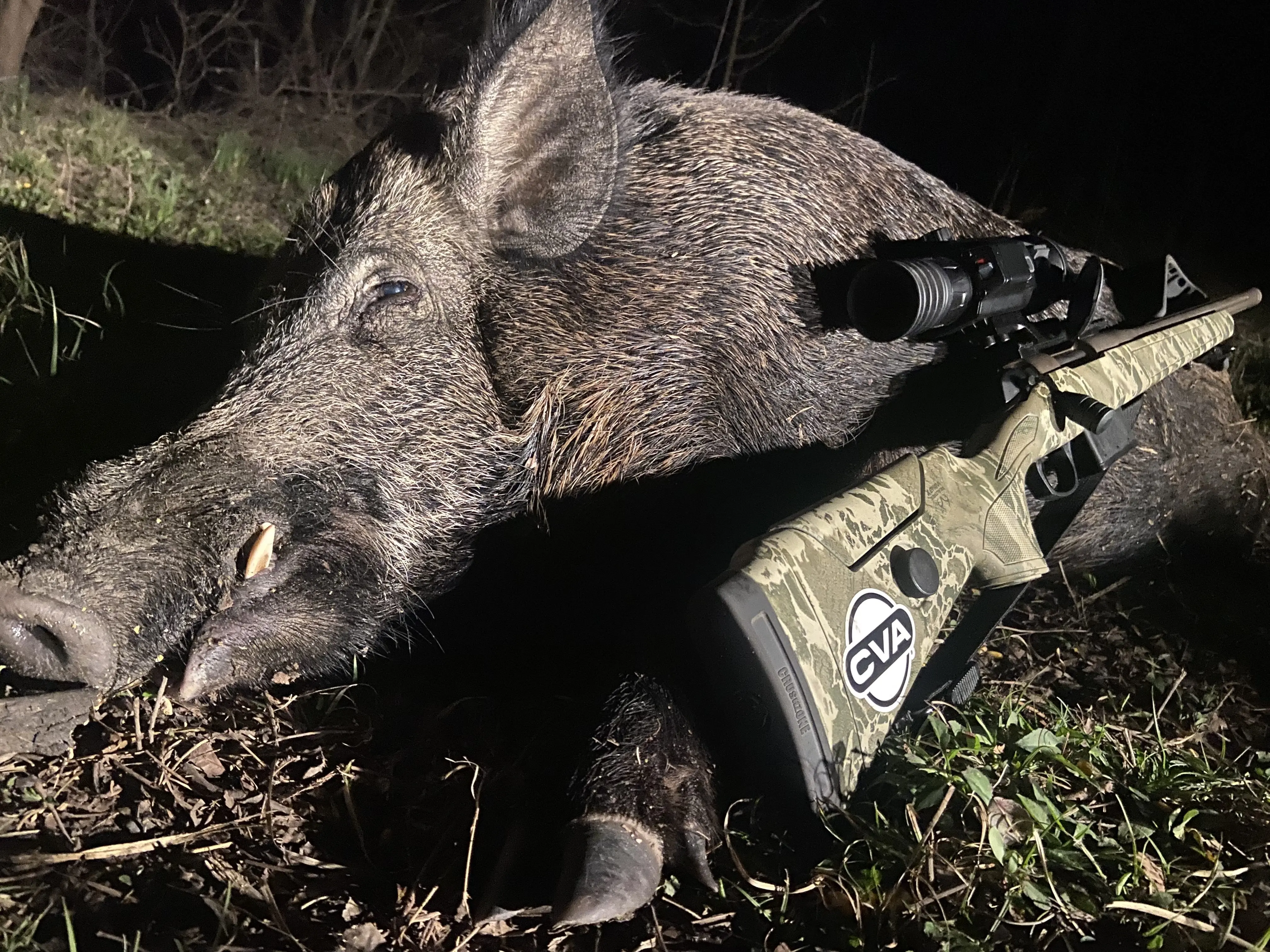
After an hour or so watching the hogs across the fence, I swiveled the chair around to the left and through the thermal picked up movement in the brush behind the corn feeder. I was hoping for one of those ‘eater’ hogs I try to target but a head the size of a yearling calf appeared with the long snout of a wild boar. This was a wild hog and from the looks of the tusks an older boar, definitely not my choice for BBQ. The hogs was a big one and looked to be almost as round as he was long, like a big football. Once he cleared the brush, I centered the crosshairs on the center of his neck and eased back on the trigger of my CVA Cascade VH. The little .223 round anchored the hog in his tracks and at first I though I had just ruined my pork procurement hunt by shooting a big boar.
When I approached the big hog, he smelled just like a barnyard hog, none of that rank wild boar smell. He was extremely fat and I decided to remove the backstraps and both hams. There was about two inches of fat over his back and I was optimistic that he might just make some great BBQ but, It would take several hours of slow smoking to make the meat tender. The night was cold so I let the quartered meat chill out in the back of my truck. The next morning, I fired up my smoker with some seasoned hickory and cut the meat into chunks, seasoned with a dry rub, placed in an aluminum pan to retain the moisture and brough the smoker up to 225 degrees. After four hours of basting and slow smoking, I checked the temperature and the meat was a safe 160 degrees but still not nearly tender enough for pulled pork sandwiches. Rather than continue tending the wood fire in the smoker, I cut the chunks into smaller pieces, placed in a big crockpot with a chunked up domestic pork loin, added a bit of beef broth and BBQ sauce and let it cook overnight on low heat! I can honestly say, I’ve never prepared better pulled pork, I think it will go over well at the event this coming Saturday!
Contact outdoors writer Luke Clayton through his website www.catfishradio.org. Catfish radio can be heard on KOXE 101.3 every Saturday at 9 am following Lone Star Trail Outdoors with Nathan Smith at 8 am. You can also listen to “Catfish Radio with Luke Clayton and Friends” just about everywhere podcasts are found.