Story and photos courtesy of Steve Nash / Special Contributor to BrownwoodNews.com
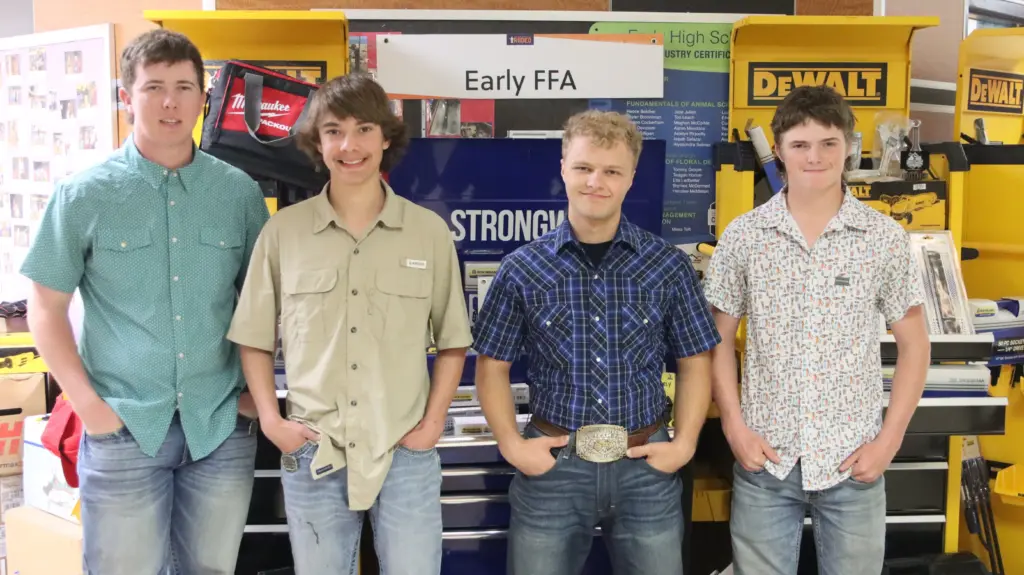
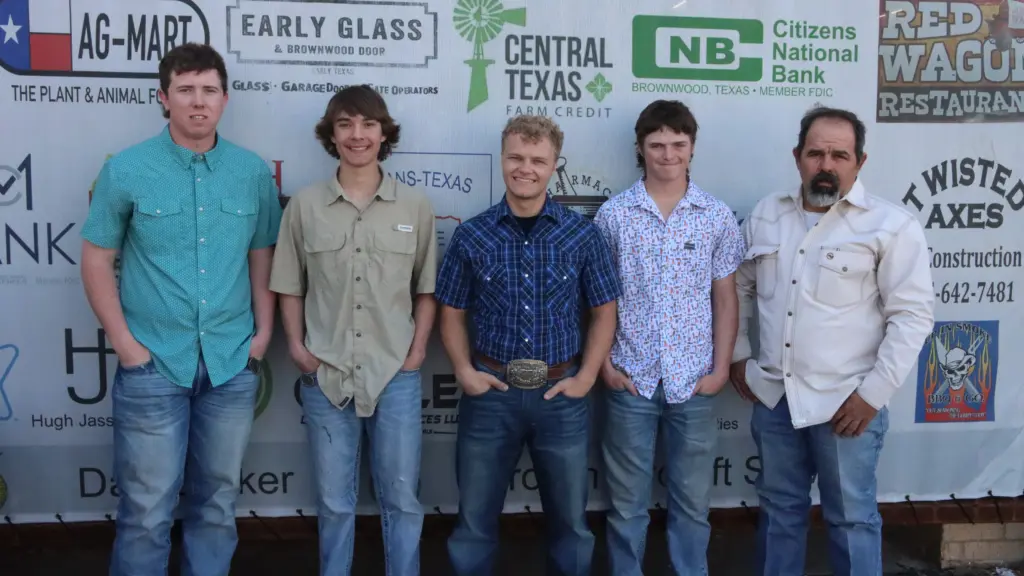
EARLY – For Early High School students Tommy Groom, Owen Johnson and Jeremiah Hopkins, the excitement of winning the 2026 Texas FFA Tractor Tech state championship at the Houston Livestock Show and Rodeo on March 9 hasn’t dissipated.
The three students are members of the Early High School FFA Tractor Tech Team, coached by Cortney Hopper.
“For a small school, it’s probably the greatest achievement that we’ve ever known,” Hopper said. “I’m very proud of them.”
Recently, Groom, a junior, Johnson, a junior, and Hopkins, a senior, accompanied by alternate team member Maddox Hair, a sophomore, gathered in the school’s ag shop to talk about the win.
“It’s something to carry for a lifetime,” Groom said. “Not many buckles say state champ on them. We walked into the Red Wagon the other day. We were talking it up with those guys about it. It’s pretty cool that the people you don’t know the names of, know about you.”
The students explained the road to the state competition.
“The only minimum requirement is to go to the area contest in Stephenville.,” Groom said. “We competed against Area 4 teams. The top three teams get to advance to state. Now us, we competed in somewhere around 15 contests this year and that helped us prepare for that area contest, helped us prepare for that state contest — just getting the pressure off, getting that experience. “
Johnson explained how the contest worked.
“It’s kind of a three-stage contest you go through and they have a test bank that’s probably about a thousand questions — all technical questions over tractor engines,” Johnson said. “You study those test questions at home. When you go to the contest, they pull 100 questions out of the bank and you score from one to 100.
“The second section is your component section. They pull out 20 parts and give you five questions over each part. Then at the debugging section, you actually work on the tractor. They give you a service work order. You have five problems with the tractor — five bugs — and you have to find them and fix them. You tell the judge how you fixed them show them the manual, and where in the manual where you found the fix.”
Johnson said teams were graded on safety, how well they worked together and, of course, their ability to repair the bugs.
There were also points for driving the tractor — although all of the bugs had to be repaired before a team could drive.
“After about 15 (previous) contests, we got used to it,” Johnson said. “We didn’t let the pressure get to us. You really don’t need pressure getting to you at a state contest.”
Hopkins explained what winning state meant to the team.
“Tractor tech was the super big thing that we focused on this year, because last year we made it to state,” Hopkins said. “But we did not score high enough on the test to get into the chips. So that really lit a fire under us to kick it into another gear to get out there and win this thing.
“I tore into that study book. I’ve read through the entire manual back to front three or four times. I’ve read everything I could about tractors. I was the person who filled out the work order, so as my two workhorses, Tommy and Owen, dug through that tractor and fixed the tractor, I was recording everything they did, flipping through the manual. So this was a huge team effort, and it meant a lot to us to win state tractor tech.”
The students described their mindsets as the state competition began.
“It’s just … going there, do what you do,” Groom said. “We knew if we did what we did and didn’t let pressure get to us, we would win it.”
Johnson said, “We finally figured ourselves out. I think, five or six contests into the season, we really figured each other out and we were doing really good. We went to the state qualifier the week before. We managed to win it. We’ve had such a good team. I don’t know if we’ve ever seen a team do this good season-wise. We felt pretty good about it.”
Hopkins said, “the biggest part of this contest is trying to keep a cool head, and try to stay in your rhythm that you’ve been in all year. For me it was a little nerve-wracking because the state contest is split in two different days. The first day you do the testing components and the second day, if you make the top ten teams, then you go to the floor and you work on the tractors.
“I have always struggled with the testing components. So it was a little nerve-wracking for me that I wouldn’t score high enough on the testing components to get these two up to the floor to the tractor and help carry our team. So the last couple of weeks I’ve dove into that study book and learned all I could for that test.”
The students explained how they became involved in ag mechanics.
Groom: “I started off my freshman year. I built a pretty simple project. It was a trailer light testing box, and that really kind of lit the flame for me. My dad does aircraft maintenance whenever he’s not at the fire station and that kind of gave me that mechanical mindset of, okay, this is the problem, how do we fix it, what else could it be. It’s kind of that mentality you have to have in tractor tech.”
Hair: “I’ve always liked building stuff. Every time I go to the fair and I’ll show the animals I’d always do the projects and I really want to do them.”
Johnson: “I’m really involved with stuff a lot. My dad works at a shop in Brownwood so he’s always welding and doing work like that. He used to work on vehicles. We do a lot of stuff at home. I would be kind of dumb to not get involved in this.”
Hopkins: “I was raised on a farm, so I’ve been around tractors my whole life. My dad was an ag teacher for the first 14 years of his career, so I was always around tractor tech and ag mechanics. This was the next step into the process.”