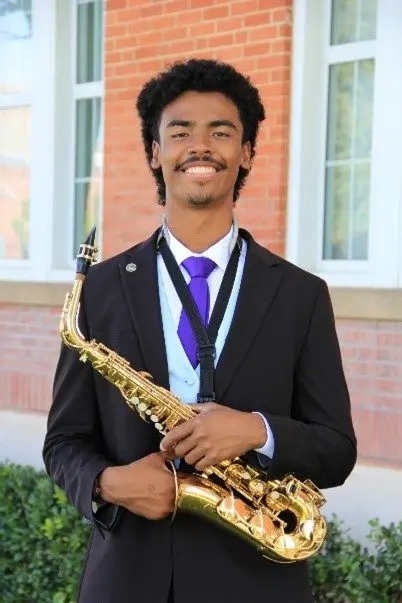
Victoriano aka Vic Cooper is a senior music and biochemistry major at Howard Payne University. He is active in theatre, concert band, jazz band, choir and chapel band. He loves making music and playing piano, violin, saxophone, guitar, drums and many other instruments. He serves at St. Mary’s Catholic Church and May’s First Baptist Church on Sunday mornings by making music and worshipping Jesus.
After graduation, Vic plans on attending medical school at Kirksville College of Osteopathic Medicine and joining the Air Force as a military physician.
He is the son of Dr. Charles cooper, who is a certified Physician Assistant with more than 25 years of clinical experience in internal and family medicine. and Mrs. Adelie Cooper, who is a RN Oncology Manager at Walker Cancer Center. He has one sibling an older brother, Dr. Abraham F.J. Cooper, who serves in the United States Air Force, and is also a graduate of Howard Payne University.
Vic can be seen around campus supporting various clubs and sport teams. He also enjoys volunteering in the community and helping non-profits.
***
This year marks the 100th Anniversary of Black History Month and Revitalizing Our Community (ROC) will be spotlighting amazing African Americans, who have made contributions to the community of Brownwood and Brown County. Black History Month was created in 1926 in the United States, when historian Carter G. Woodson and the Association for the Study of Negro Life and History (ASNLH) announced the second week of February to be “Negro History Week”. This week was chosen because it coincided with the birthday of Abraham Lincoln on February 12 and that of Frederick Douglass on February 14, both of which Black communities had celebrated since the late 19th century
Black educators and Black United Students at Kent State University first proposed Black History Month in February 1969. The first celebration of Black History Month took place at Kent State a year later, from January 2 to February 28, 1970.
Six years later, Black History Month was being celebrated all across the country in educational institutions, when President Gerald Ford recognized Black History Month in 1976, during the celebration of the United States Bicentennial. He urged Americans to “seize the opportunity to honor the too-often neglected accomplishments of Black Americans in every area of endeavor throughout our history.”