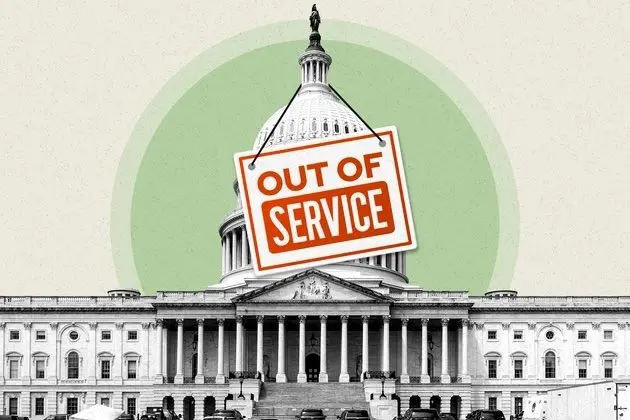
The U.S. Federal Government has now been shut down for weeks, with 12 failed votes to reopen and pass a Congressional budget. Both Republican and Democrat politicians have taken to the news, pointing blame for the shutdown and failing to reach a solution. This article addresses false narratives consuming the news, and dives into the specific point of contention within the Senate.
SHUTDOWN UPDATES
The Congressional budget funds the federal government according to the modern budgeting process that was established back in 1976. It was part of the bipartisan Congressional Budget and Impoundment Control Act of 1974.
At the end of every FY, Congress must pass 12 appropriation bills for all twelve appropriation subcommittees in order to keep the government open and funded. If they are unable to do so, Congress members must then create a continuing resolution that will temporarily fund the government by maintaining funding levels from the previous year until a full budget passes.
The FY ends on September 30th, mandating the passage of a new budget or else risk a government shutdown. 3 weeks ago the Senate failed, and the government has remained closed since. The proposed appropriation bills were voted against by Democrats and a continuing resolution has not been created.
There have now been 12 voting sessions to reopen and fund the government, all of which Democrats have remained staunchly opposed to every round. On October 14th, the Office of Personal Management notified Congress that it would be using $8 billion of unspent funds to ensure that American troops are paid. Federal departments have begun to lay off around 4,000 workers with Reduction in Force (RIFs) notices.
As of October 23rd, the appropriation bill has been blocked to pay military and essential federal workers.
FALSE NARRATIVES
News updates have been spewing various pointed accusations regarding the shutdown – far from mitigating the polarity of the problem and feeding into the politicians’ illustrious accusations. Some say Republicans are wanting to deny access to healthcare across the board with their proposed budget, and that they don’t need Democrats to pass the budget since they hold the majority in both House and Senate. Others say Democrats continue to vote against the proposal, because they want to give illegal immigrants free access to healthcare.
The bottom line is that both narratives aren’t entirely true. The only truth is that Democrats have voted against the Republican proposal 12 times. So, let’s talk about it.
SENATE FILIBUSTER RULE
The U.S. Senate is held accountable by a rule intended to eliminate debates with no end in sight. This is the Senate Filibuster Rule. A filibuster is an endless debate where no one is reaching a solution. Famously, Texas Senator Ted Cruz once maintained a filibuster on the Senate floor by reading Green Eggs and Ham in 2013, and New Jersey Senator Cory Booker delivered a speech that lasted 25 hours in April.
Basically, it’s a way for politicians to waste time and delay doing their jobs. Nonetheless, the rule mandates that the Senate obtain a 3/5 majority to end the filibuster and come to a decision. This requires a proposal to get 60 votes to pass. It does not matter which party holds the branch majority.
As it stands, Republicans only occupy 53 seats so, while still the majority, they cannot make up the seven other seats on their own. Because of this, Republicans actually do need bipartisan support, but Democrats have become “policy riders” as they hinge their vote of opposition on a single policy issue regarding ACA subsidies.
AFFORDABLE CARE ACT SUBSIDIES
Within the Republican budget proposal, it is written to eliminate the extension for subsidies implemented by the Obama-era Affordable Care Act. These subsidies were made to resolve the problem with unaffordable healthcare in the U.S.
The U.S. healthcare system is simply just a patchwork of various sorts of coverage. When companies and organizations offer jobs with health insurance benefits, this is an example of private healthcare. Medicaid is a sort of coverage for those who need financial assistance to receive healthcare. Medicare is a sort of coverage for people typically 65+ years or older.
ACA was made as a way for people who make too much money to qualify for Medicaid, are too young for Medicare, and don’t have a job that provides health insurance to receive private coverage. The specification of ACA makes coverage affordable based on an applicants’ income. The reason Republicans proposed to cut the extension of ACA subsidies was because it adds tens of billions of dollars a year to the federal budget; and one of the biggest contentions for this administration is to minimize the deficit and cut back government spending.
The difference is that Democrats believe the cost is worth it, while Republicans believe it’s frivolous – but both acknowledge the financial expense.
Republicans have implemented additional steps for eligibility verification for Medicaid and other healthcare related systems within Public Law 119-121. This verification is intended to affirm an applicant’s citizenship. If citizenship status is not verified, states are then required to deny the applicant healthcare benefits. If states fail to safeguard healthcare benefits from individuals without lawful status, federal payments/funding are then limited.
This is the cause of the 12 failed votes. Democrats have provided the Senate with a counterproposal, contending that it’s not about granting illegal aliens free access to healthcare but Republicans remain unrelenting.
Section 2141 of the counterproposal suggests that changes made to health-law by Republicans (tightening eligibility verification) be revoked and ACA subsidies be restored. Here’s the deal.
8 U.S.C. 1611 already prohibits the provision of federal public benefits to illegal immigrants, Medicaid being included. Emergency Medicaid and state-funded programs, however, still cover illegal immigrants in a time of emergency. So, it seems to be that this shutdown is a battle between federal intervention and states’ rights.
Should the federal government step in to safeguard health care benefits for American citizens? Should Republican lawmakers relent their grip on ACA subsidies to reopen the government? Are state-funded programs providing emergency care to illegal immigrants exploiting loopholes in federal law?
IMPORTANCE OF FUNDING
The bottom line is that all Americans can agree that a government shutdown is harmful and costly. Let’s review just how harmful this is as we wait for politicians on Capitol Hill to find common ground.
Federal government agencies and programs rely on the Congressional budget for funds every year. If it is not passed through the Senate, they are forced to halt all non-essential functions. In its’ fullest extent, a government shutdown effects Social Security, Medicare, environmental agencies and food inspection, air travel, Health and Human Services, etc.
In its’ lesser extent, a government shutdown stops all non-essential functions. To be considered non-essential means the function or position is not authorized by law (Social Security payments), is not necessary to protect life and property (law enforcement); and is not needed to facilitate an orderly shutdown (the issuance of furlough notices).
It’s no mystery that a government shutdown is harmful and costly, but let’s discuss the particular reasons why.
- Indirect and Direct Costs
The direct cost of a government shutdown is regularly impacted by the need to pay federal employees for the work they missed during a shutdown. The indirect cost is a bit more ambiguous as it regards an economic disruption and the increase of administrative work to compensate.
The Office of Management and Budget estimated that the 2013 shutdown that lasted a total of 16 days cost the federal government nearly $2 billion.
- Economic Impact
A shutdown effectively increases unemployment and lowers GDP growth, ceasing economic expansion.
- Federal Workforce
The furlough of an employee is a temporary discharge, especially to compensate for unfortunate economic conditions. When the government shuts down, non-essential government staff are the first to go. This could later impact recruitment and retention in the workforce. Looking at the bigger picture, this also could later impact federal grants, subsidies, and benefit programs.
If there is anything that every American voter and politician can agree on, it is that a government shutdown is never preferred or beneficial to the system.
***
Katelyn Sims is a senior at Howard Payne University, pursuing a Bachelor of Arts degree in social science with emphasis in American political studies, global studies and jurisprudence. She is also a student in the university’s Guy D. Newman Honors Academy, as well as a prominent member of the Student Speaker Bureau speech and debate team. Following graduation, Katelyn will pursue a career in the field of U.S. foreign policy.
Katelyn has worked as a news writer and marketing coordinator with Brownwood News since 2023. Her column The Truth Will Set You Free is intended for all people from all walks of life. Katelyn aspires to inform readers of major U.S. political and legislative activity with an unbiased analysis that engages with political ideologies on all sides of the aisle. She believes the public ought to exercise their free will to cultivate personalized opinions on controversial issues without the influence of mainstream media.