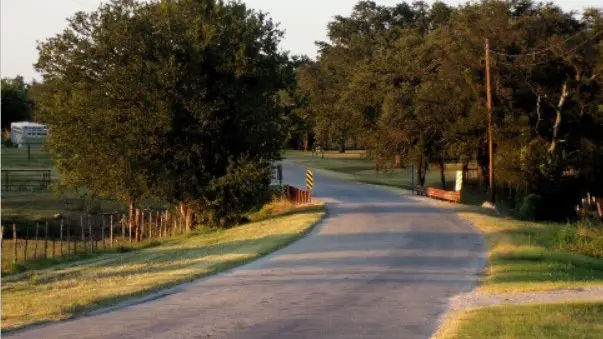
There’s a slow rhythm to a small Texas town on a Saturday morning. The lazy waves of neighbors and friends stopping to pass the time of day, grandparents and grandchildren riding in to gas up the old farm truck–these things bring me a quiet sense of peace. All is well in the world when a dusty tractor is meandering along in front of me on these slow paced mornings, taking life easy after a hard week of work. I am happy to oblige.
In fact, in the smaller communities, many ways of living, including the old-fashioned ways of Saturday morning visits and gossips, aren’t much different than they were in October of 1894, when a special correspondent for the Brownwood Bulletin drove his horse and buggy along probably what is now Old May Road, from Brownwood to May and wrote about what he saw. “This highway winds for miles and miles, amidst clustering shades and through fertile lands, away up the grand valley of the Pecan Bayou. When irrigation comes to bathe the prolific soil of this great valley with bright sparkling waters, it will indeed become a charming paradise. ” the reporter wrote. The article describes the reporter’s stops at various homes along his way, and the route itself in different language than we often use today. It is the older way of speaking, tied to the land and the people.
There were not a lot of road numbers in 1894, rather things were named in a more intimate fashion–one that was more personal and evocative. It was always “going up to the Adams” place, to make myself an example. You did not travel down highway 183 exactly. There was more to it than that. The names of neighbors, descriptions of landmarks and even events that took place at a location were used to describe places. “As you cross the iron bridge over the bayou going out from the bustle of the charming rural regions of evergreen Brown, the cotton fields, pecan foliage and beautiful homes of the Swinden plantation with the green woodlands and beautiful cottage of the Fitzgerald home present landscapes truly charming to the vision and most eloquently suggestive of the magic chain that has swept over this luxuriant valley in the past ten years,” the Bulletin correspondent wrote.
“On a tributary of Salt Creek rests the comfortable Anderson home with its hundreds of acres of well tilled land. Just a glance at the broad expanse of this farm is enough to show what honest labor will produce.” … “the homes of the Womacks, Clemens, Mosleys, Gibsons, Dikes, Tunget, Looney, McBrides, Story, Gordons, and other worthy people cluster in this fertile region.”
“A drive from William Anderson’s a little further up the road, brings to view the massive proportions of Salt Mountain, and features of the lovely Salt Creek valley. When Salt Mountain comes to view, the name and fame of Col. S.P. Burns, the democratic nominee for representative is remembered. At the base of this noted peak is the home of this gentleman. He is recorded as one of the best farmers of the state. Just as the shades of eve settled on these landscape pictures The Bulletin tourist raised the latch string of the comfortable and hospitable home of C. F. Evens. The Bulletin calls him “Lum” for short. By this name, he was loved as a good student of Coggin Academy in the dear years.”
Towns out here over 100 years ago were often much smaller than they are now. It seems everyone knew most everyone else. This connection was also related to the land itself I think, to a knowledge of places and events that tied a community together. I think those elements still create a special magic, a sense of harmony that makes a town lovely and peaceful.
I can see our cheerful Bulletin reporter taking his drive to May on a Saturday morning, stopping to chat with the Andersons, having lunch with Col Burns as he meanders through the sunlit countryside speculating on irrigation improvements and how beautiful the valleys are. It is rhythmic, slow and lazy, yet filled with purpose. There is still this type of connection in the small towns around us today. The people and the land are closer together in these places, and what that creates is a gentle, joyful sense of well-being. I wonder if that nameless, long gone reporter felt the very same thing when he drove out that day to see the sights and stop and chat along the way?
***
Diane Adams is a local journalist whose columns appear Thursdays on BrownwoodNews.com. Comments regarding her columns can be emailed to littleadams@gmail.com.