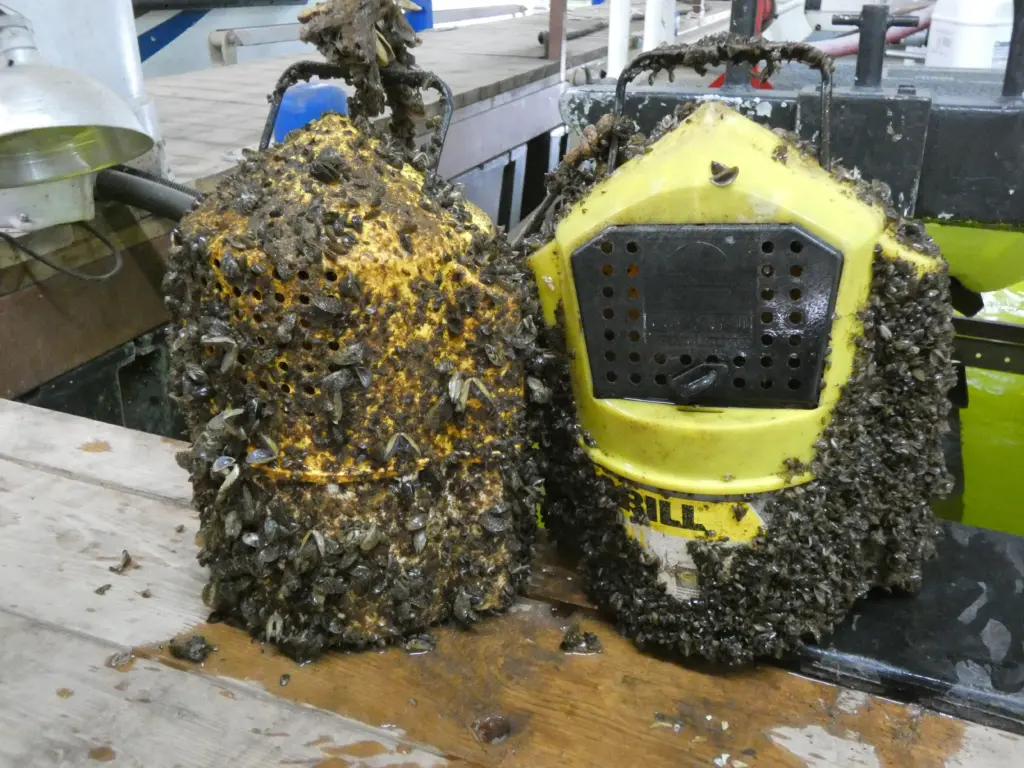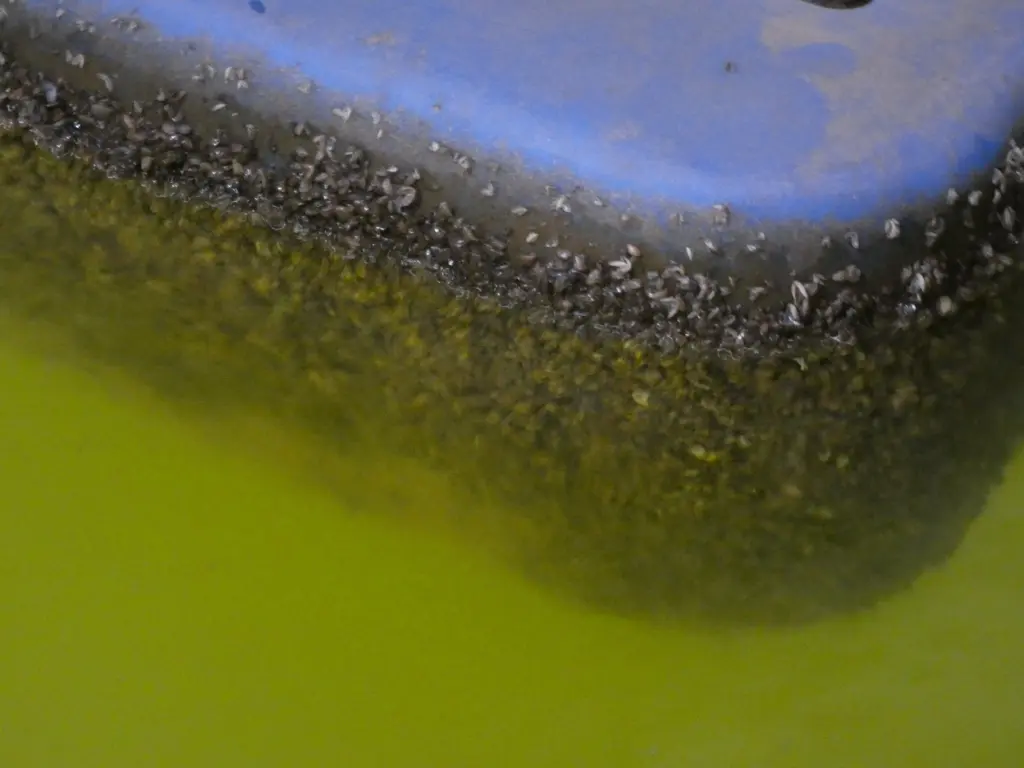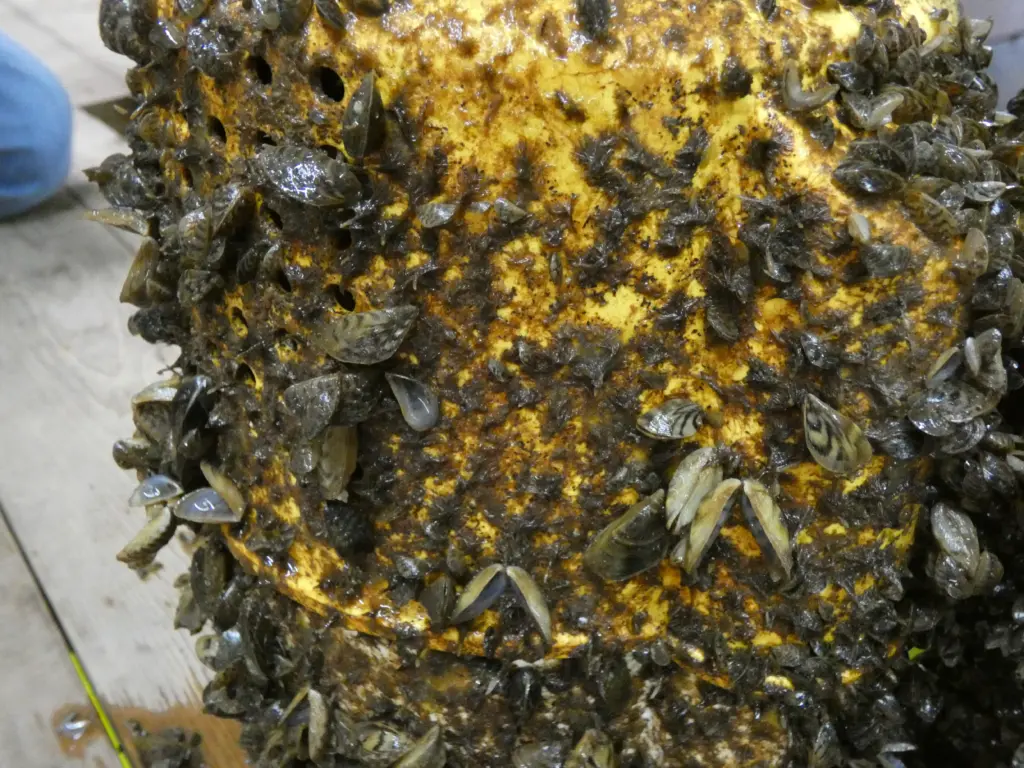
The population of zebra mussels is increasing in Lake Brownwood, according to officials with the Brown County Water Improvement District. John Allen, General Manager of the Water District, and Marcus Lively, Chief of the Lake Patrol, both have said that they have observed more zebra mussels in Lake Brownwood this summer.
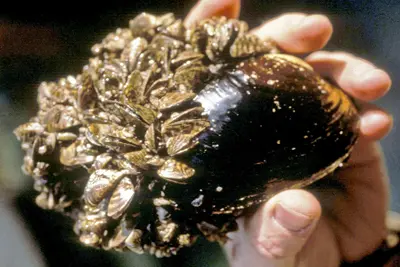
Zebra Mussels, according to the National Park Service website “are small, freshwater bivalve shellfish.” A pattern of black, zig-zag stripes on their shells give them the name “zebra.” Zebra mussels originated in Ukraine and southern Russia. From there they hitched a ride on ships around the world. In the late 1980’s they first appeared in Canada and the United States in the Great Lakes region. Zebra Mussels came to Texas at Lake Texoma in 2009, and then were first sighted in Lake Brownwood in November 2020. Currently 34 Texas lakes have zebra mussels, including Lake Buchanan, Lake Canyon, Inks Lake, Lake Nasworthy, and Lake O.H. Ivie.
The National Park Service says zebra mussels “are filter-feeders that siphon particles of plankton from the water. They are highly efficient at this, and a large population of mussels can quickly clear the water of almost all floating particles. This change can cause shifts in local food webs, both by robbing food from native species that feed on plankton, and also by increasing water clarity and thus making it easier for visual predators to hunt… Once a population of zebra mussels has become established in a water body, there is very little to be done to remove them.”
After the zebra mussels first appeared in Lake Brownwood, the population grew rapidly for a few years, then seemed to decline. Now their numbers apparently are growing again. A formal census of the zebra mussel population is almost impossible, but population statements are based on observational and anecdotal evidence.
Michael Homer is the Texas Parks and Wildlife “Fisheries Biologist” based in Abilene. He commented: “With Lake Brownwood catching water, it’s very possible that you had an influx of nutrients that created more favorable conditions for zebra mussels to become more established in different locations. We were in a pretty severe drought going into last summer. We have since caught a bunch of water, and now that it has had some stable water levels for a while, you’ve had some flooded areas, and you’ve had a lot of stuff wash into the reservoir that zebra mussels can take advantage of, as various sources of food. And the same thing with our fish populations.” In general, zebra mussel populations increase in the summer, and decrease in the winter.
Homer said that zebra mussels “can be problematic in various ways, from clogging water intakes, to clustering on docks, boats, and motors. When it comes to other species, they can be problematic in that they can remove a lot of plankton that serves as important prey for juvenile fish.”
The lifespan of zebra mussels is up to four or five years. An adult female zebra mussel can produce 30,000 – 40,000 eggs in each reproductive cycle, for a total of over one million eggs per year. Each zebra mussel can process up to one liter of water per day. That does clear up the water some, which has both advantages and disadvantages. Catfish do like to eat zebra mussels, if they find some floating in the water, according to Lake Patrol Chief Lively. There have been some reports of increased populations of yellow perch and smallmouth bass in other lakes with zebra mussels. But fish in other lakes are sometimes harmed. “So far we have not seen a dramatic attack on the fish population (in Lake Brownwood),” said Fisheries Biologist Homer, “but certainly they (zebra mussels) are present and we cannot eradicate them.”
There is no treatment available to control or kill the zebra mussels in Lake Brownwood. The Water District did build some equipment that keeps the zebra mussels out of the intake water line that goes from Lake Brownwood to the District’s water treatment plant in town.
The spread of zebra mussels from one body of water to another is almost always accomplished by mussels attaching to a boat that is taken out of an infected lake and then subsequently placed in another, uninfected lake. The Texas Parks and Wildlife Department strongly recommends that any boat removed from an infected lake be cleaned immediately. This includes spraying the boat hull, motor, propeller, anchor, and trailer, and draining live wells. Michael Homer recommends more: spray the boat with a high-pressure sprayer using hot water (140 degrees F or hotter). Then leave the boat out of water for at least five days in the summer, and a few days longer than that in cooler weather.
Any zebra mussels found on docks, floats, pipes, etc. can be removed by scraping with a flat-blade scraper made of metal or plastic. Do not scrape with your hands, as the shells of the zebra mussels are very sharp and will cut your skin. In fact, if zebra mussels are observed in a swimming area, swim shoes are strongly recommended.
The battle against zebra mussels in Texas is ongoing. Michael Homer urges everyone, if zebra mussels are observed in a new body of water, to notify the nearest Texas Parks and Wildlife District Fisheries office, or alert online at TexasInvasives.org. For more information on zebra mussels, contact that same website: TexasInvasives.org.