A lot of rain has fallen so far this week. Some flooding is happening, but the sort of flooding we have today is not anywhere near the scope and size of floods before Lake Brownwood Dam was built. Mainly our worries are traffic, being late for work, flooding fields or dangers to livestock. 100 years ago, a flood along the moody Pecan Bayou was a terrifying prospect that could take years of labor and tons of money to repair.
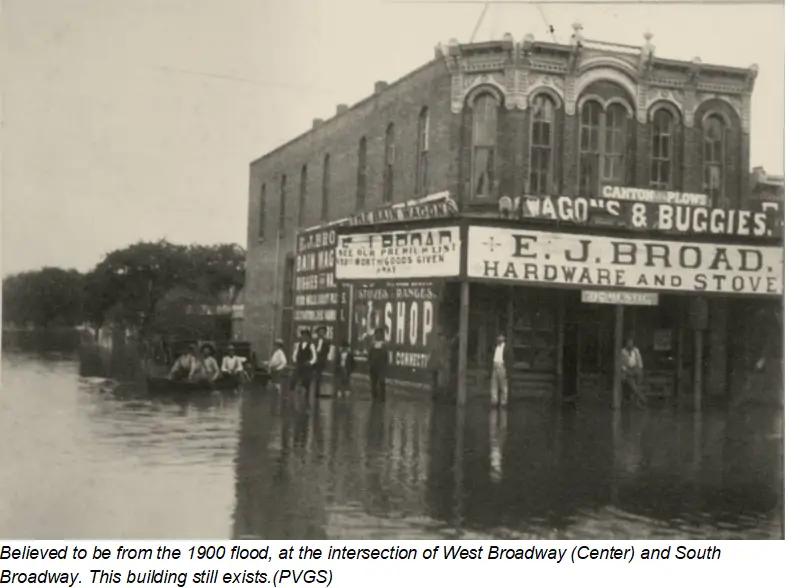
The flood of 1900, when Brownwood was fundamentally swallowed by Pecan Bayou, extended throughout most of the city. “The Pecan Bayou has had the largest overflow known since Brownwood became a frontier settlement,’ an article in the Galveston Tribune, dated Sept 25, 1900 reported. “The water rose six feet over any previous high water mark before it stopped. This statement is made on the authority of Messrs. Clay Parks and S.R. Coggin, two of Brownwood’s pioneers. The damage to the cotton crops along the Jim Ned valley can not be estimated with any certainty, but thousands of acres have been underwater for two days. J.R. Looney, a prominent merchant, says 5,000 to 7,000 bales will be lost. No loss of life has occurred so far as known. Many cattle and horses have doubtless been drowned, for the valley is from one to five miles wide, and all of it covered with swimming water,” the report stated. “Over 100 families have been forced out of their houses, and much of their effects are ruined from their long stay in the water. Nearly every team in Brownwood was kept busy all of Saturday night rescuing families. All day Sunday boats paddled through a portion of Center Avenue and West Broadway.”
While we zoom right over a swollen, roaring bayou on the way to work or lunch, maybe glancing out a window to see how high the water is, once upon a time, crossing the bayou when it was flooding was a life-threatening undertaking. Local historian Jay Longley dug up a report about a man who was drowned trying to cross the rising bayou in an edition of the Austin Weekly Statesman from May of 1884. “Mr. S.J. Bird, a citizen of this county, was drowned here this evening while attempting to cross the Pecan Bayou in a skiff. Mr. Brown and his son, who was rowing the skiff, came very near drowning also. Mr. Bird’s body has not yet been recovered. There was a very heavy rain here last night, and the bayou is very full. A bridge is very much needed here. There is not a single bridge or ferry on the Pecan Bayou from the head to the mouth. The inconveniences to our citizens and the travelling public is very great on this account. It is to be hoped that our commissioners court will act in this matter before more lives are lost.”
I am not sure when a bridge was first constructed, but, according to local history buff Frank Griffin the old crossing on Pecan Bayou was located along what is today FM 2525. Frank’s grandparents owned the house at the crossing. “The area around my grandparent’s house was an old wagon yard, because the crossing was also the main road across the bayou. When the river was on a rise people would camp around the house until they could cross. Dad said that when he was a kid a lot of people would still cross the river there to go into Brownwood, because the horses wouldn’t cross the iron bridge where CC Woodson crosses now. The road was still visible when I was growing up,’ Frank stated. I went out there to try and find the crossing, but was not able to locate it. I will try again, as I think it’s worth noting. It is likely that the drowning victim, poor Mr. Bird, was attempting to get across at this location.
The flood of 1900 was a breaking point for Brownwood. It washed out several miles of freshly laid railroad track, creating a shortage of supplies and further isolating those impacted by the water. This led to calls for water control that eventually resulted in the building of Lake Brownwood Dam. While we are watching water rise around us this week, with some back roads becoming impassable and a few streets flooding in town, it’s a big improvement from the old times when you’d take your life in your hands to cross the bayou at flood stage!
***
Diane Adams is a local journalist whose columns appear Thursdays on BrownwoodNews.com. Comments regarding her columns can be emailed to littleadams@gmail.com.