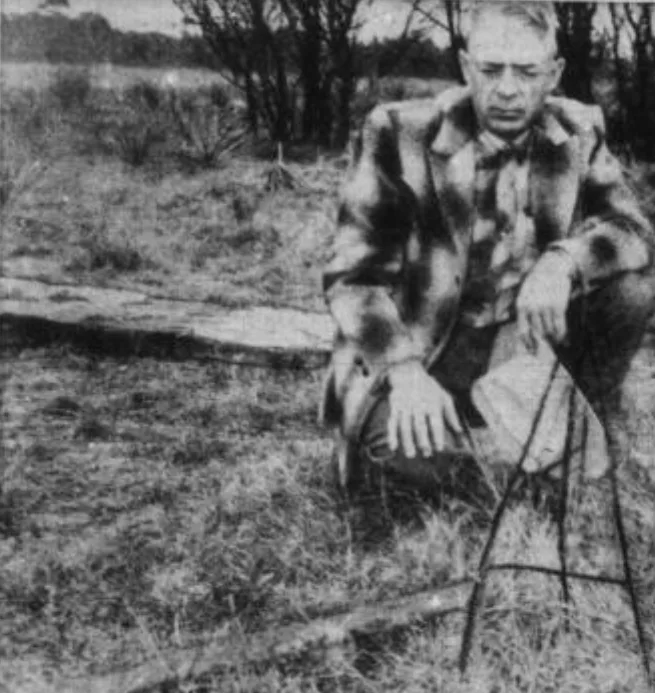
Reader James Davis takes a particular interest in Brown County history as a descendant of two pioneering families in the area. Mr. Davis recalled hearing from his late brother Ernest about the German prisoners of war held at Camp Bowie. James’ father, Ed Davis, was a senior partner with the Davis-Morris Funeral Home in Brownwood, and prepared the bodies of deceased soldiers from the POW camp for burial. Interestingly, I was out at Jordan Springs Cemetery a few months back, where these soldiers were originally buried. At the back of the cemetery, within a separate enclosure, is a lot with a rock walkway that was placed there at the time of the burials, marking the place where the graves were located.
The story of the German soldiers held at Camp Bowie during World War II begins with the establishment of the Camp Bowie Internment Camp in 1943. According to the browncountyhistory.org, “The camp was located in the valley immediately below the dam on the Brownwood Country Club property.” The camp was heavily guarded, constructed inside a tall barbed wire fence and secured by machine gun-armed guards and dog patrols. It had the capacity to hold some 3,000 men, and by September 1943 was an unwelcome home to 2,724 prisoners.
While I’m sure the German prisoners did not love life at the Camp Bowie facility, the camp was nothing like the horrific conditions suffered by prisoners in the German camps of Europe. The captives took classes in farming, forestry, building, and bookkeeping classes. There was a theater in each compound, a woodworking shop, billiards tables and even soccer and tennis fields. Many of the prisoners may actually have gone to the movies in Brownwood regularly. Despite the relatively comfortable conditions, 5 or 6 soldiers did die at the Bowie facility during their internment.
According to an account in The Brownwood Bulletin from 1969, the prisoners who passed away at the POW camp in Brownwood died from illnesses. They were buried on what was then part of the Camp Bowie grounds, and is now Jordan Springs Cemetery. The care of the German portion of the cemetery was given entirely to the prisoners of war, who worked a vegetable garden located nearby. A barn on what the Bulletin article called the old Bailey place was virtually beside the cemetery, and was used by the prisoners to store crops. At the time the newspaper article was written, the barn was still standing but in disrepair. I doubt much if anything is left of it today.
The gardens were for providing fresh veggies for the prisoners. “Work in the gardens and the cemetery afforded the prisoners of war ways to make POW camp days seem shorter and in addition the garden furnished some food to brighten prisoner of war diets,” the Bulletin said.
At Jordan Springs, you can still see the rock walkway these soldiers built, and there are a few scattered rocks around that are said to have once marked the POW graves. Through the guidance of the President of the Jordan Springs Cemetery Association, Jerry Richardson and his wife Martha, I learned that many of the prisoners actually had employment with local businesses and ranchers. Richardson said that all but one of the bodies were exhumed and taken back to Germany, the exception being one that was too far along the path of decomposition to be shipped home. I could not discover the names of those who were buried at Jordan Springs, or anything about the soldier who is said to have been left behind there. I bet if James Davis’ father were still alive, he could tell us!
***
Diane Adams is a local journalist whose columns appear Thursdays on BrownwoodNews.com. Comments regarding her columns can be emailed to littleadams@gmail.com.